Greenlyhttps://www.greenly.earth/https://images.prismic.io/greenly/43d30a11-8d8a-4079-b197-b988548fad45_Logo+Greenly+x3.pngGreenly, la plateforme tout-en-un dédiée à toutes les entreprises désireuses de mesurer, piloter et réduire leurs émissions de CO2.Greenlyhttps://www.greenly.earth/Greenly, la plateforme tout-en-un dédiée à toutes les entreprises désireuses de mesurer, piloter et réduire leurs émissions de CO2.Descending4
“The EU is taking decisive steps to clean up its supply chains - starting at the border. ”
To prevent companies from evading climate regulations by relocating production to countries with laxer standards, the EU has introduced the Carbon Border Adjustment Mechanism (CBAM), a tool designed to level the playing field and curb carbon leakage.
This initiative addresses an important concern: approximately 23% of global CO₂ emissions are embedded in traded goods - meaning nearly a quarter of emissions - are tied to products manufactured in one country and consumed in another.
A transitional phase kicked off in October 2023, introducing new reporting requirements for importers of certain carbon-intensive goods.
While the definitive CBAM system begins in 2026, the first financial settlement will take place in 2027, when importers submit their first annual declaration and surrender CBAM certificates for 2026 imports.
Companies need to start preparing now - including businesses outside the EU.
In this article, we’ll cover:
What the CBAM is and how it fits into the EU’s climate strategy
Why the mechanism was introduced, including the problem of carbon leakage
How it works – including timelines, reporting rules, and what products are affected
What changes to expect after 2026, including carbon pricing and penalties
Who the CBAM applies to
What businesses need to do to prepare, and how Greenly can help support compliance
What is the EU Carbon Border Adjustment Mechanism (CBAM)? An overview
“The Carbon Border Adjustment Mechanism (CBAM) is the EU’s latest tool in the fight against climate change, and it’s designed to make sure emissions aren't just exported outside the bloc’s borders.”
As the EU tightens its climate policies through instruments like the Emissions Trading System (EU ETS), there’s been growing concern about carbon leakage.
Note : carbon leakage is when companies shift carbon-intensive production to countries with weaker environmental rules, or when EU products are simply replaced by more polluting imports.
To address this, the CBAM places a carbon price on certain imported goods to reflect the emissions released during their production. In other words, it ensures that imported products face the same carbon costs as those made within the EU.
“According to the European Commission, the aim is to “put a fair price on the carbon emitted during the production of carbon-intensive goods that are entering the EU, and to encourage cleaner industrial production in non-EU countries."”
This is particularly relevant given that imports of carbon-intensive goods into the EU account for over 20% of the EU’s total emissions.
CBAM adopted – 10 May 2023
The EU adopted the Carbon Border Adjustment Mechanism as Regulation (EU) 2023/956.
The transitional phase began on 1 October 2023, with detailed reporting rules adopted through an implementing regulation on 17 August 2023.
Transitional reporting period – October 2023 to December 2025
During this phase, EU importers were required to report the embedded greenhouse gas emissions of CBAM-covered goods on a quarterly basis.
The final transitional report (covering Q4 2025 imports) was due on 31 January 2026.
Definitive phase begins – 1 January 2026
CBAM has now entered its definitive phase. Importers must register as authorized CBAM declarants and comply with the full regulatory framework.
The first annual declaration and certificate surrender will take place in 2027, covering emissions embedded in goods imported during 2026.
Note : to learn more about CBAM and how Greenly can help, check out our CBAM one pager.
Why was the CBAM created?
“The EU has set ambitious climate targets, aiming to cut carbon emissions and other greenhouse gases by at least 55% by 2030 and to become climate neutral by 2050. To meet these goals, the EU has steadily introduced stricter climate policies, with the EU Emissions Trading System (EU ETS) at the heart of its strategy.”
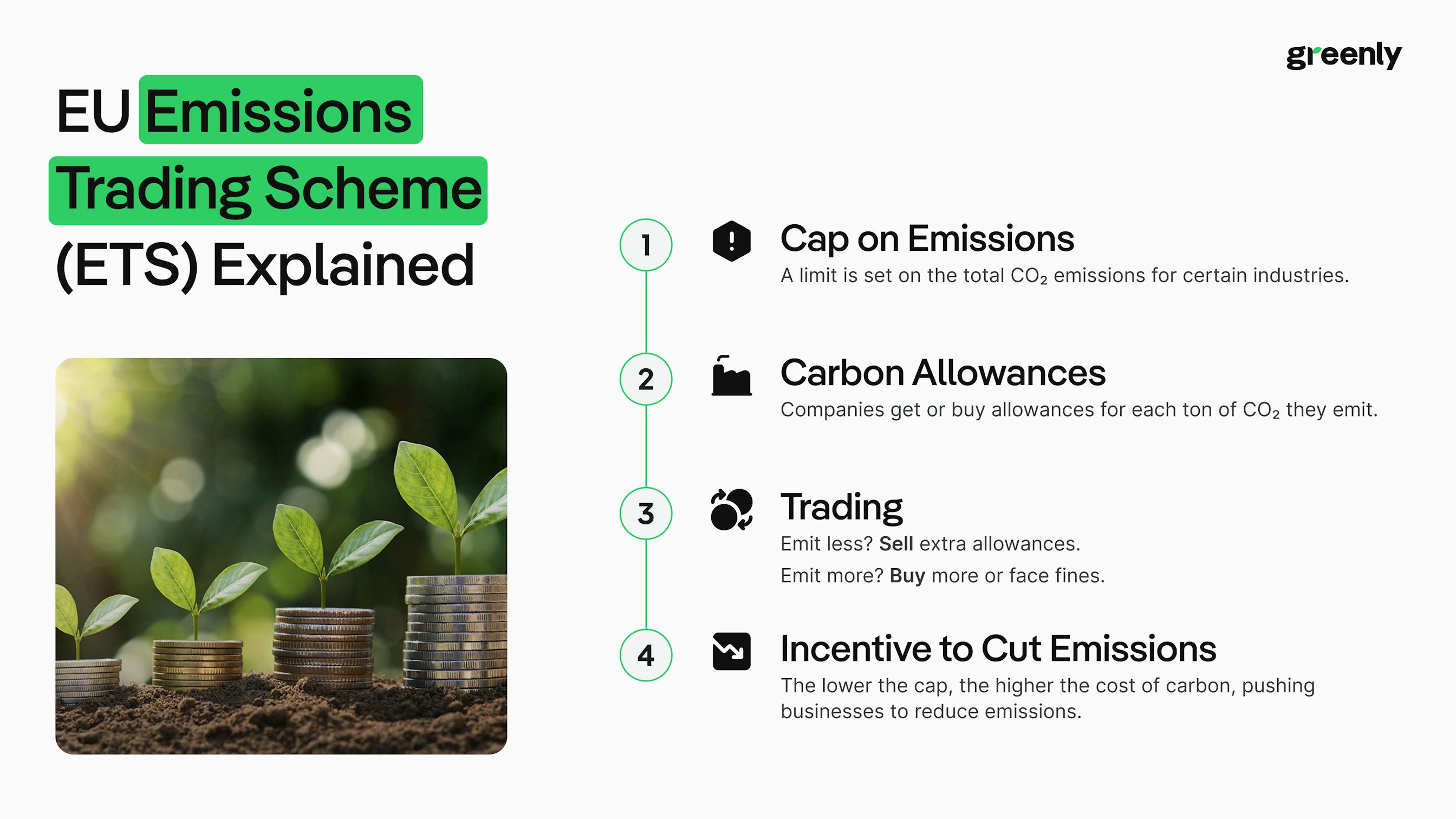
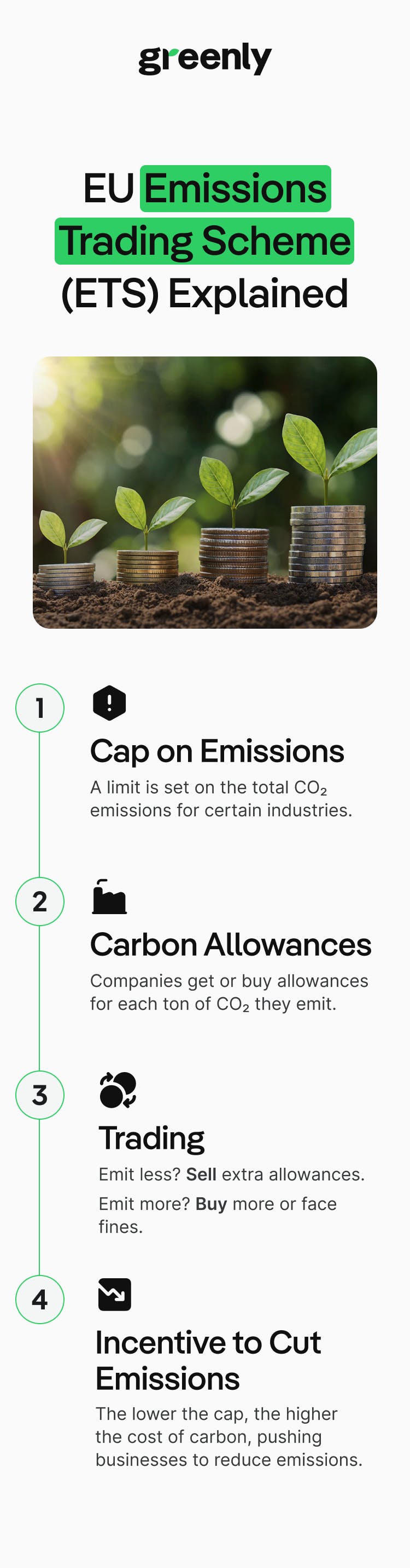
The ETS is the world’s first and largest carbon market and works by putting a price on carbon. It sets a cap on the total amount of CO2 that can be emitted by certain sectors each year, and companies must hold carbon allowances to match their emissions.
🟢
If they emit less, they can sell their surplus allowances.
🔴
If they emit more, they must buy extra or face penalties.
Over time, the emissions cap is reduced, increasing the pressure to decarbonise.
To support the EU industry during the early years of the scheme, free allowances were granted to certain energy-intensive sectors. However, these are being phased out between 2026 and 2034 to ensure the system continues to drive emissions reductions.
Note : since its launch in 2005, the ETS has helped to cut emissions in sectors like power and heavy industry by around 47% (compared to 2005 levels). But one major weakness has persisted: carbon leakage.
Close
What is carbon leakage?
Carbon leakage occurs when companies move their production to countries with weaker climate policies to avoid the costs of carbon pricing, or when lower-cost, high-emission imports replace EU-made products.
The result? Emissions are simply outsourced, not reduced.
“Carbon leakage refers to the situation that may occur if, for reasons of costs related to climate policies, businesses were to transfer production to other countries with laxer emissions constraints. This could lead to an increase in their total emissions.”
Because the ETS only applies within the EU, it can’t prevent emissions shifting across borders. Research by the European Central Bank has shown that some companies have already relocated their most carbon-intensive operations outside the EU, undermining the impact of the ETS.
To address this loophole, the EU proposed the Carbon Border Adjustment Mechanismon 14 July 2021 as part of the “Fit for 55” climate package. The goal? To apply a carbon price - similar to a carbon tax - to imported goods from countries not covered by the ETS, and ensure that EU climate efforts aren’t undercut by cheaper, more polluting products made abroad.
Close
How does the Carbon Border Adjustment Mechanism work?
The Carbon Border Adjustment Mechanism (CBAM) requires importers to account for the greenhouse gas (GHG) emissions embedded in certain carbon-intensive goods they bring into the EU.
These emissions are tied to how the goods were produced, whether entirely or partially outside the EU, and will soon carry a carbon cost, similar to what EU producers already face under the Emissions Trading System (ETS).
“The mechanism ensures that companies can’t avoid climate regulations by simply relocating production abroad or importing cheaper, high-emission alternatives, and encourages cleaner industrial practices globally.”
Who does CBAM apply to?
CBAM applies to EU-based importers of specific goods produced outside the EU or in countries not covered by the EU ETS.
This includes:
🔵
Iron and steel
🟣
Cement
🔴
Aluminum
🟢
Fertilizers
🟡
Electricity
🟠
Hydrogen
🟤
Certain downstream products made of iron and steel (such as screws, bolts, and similar items)
Note : whether or not a product is subject to CBAM depends on its Combined Nomenclature (CN) code. The full list of CBAM-covered goods and corresponding CN codes is available in Annex I of the CBAM regulation.
Close
Are there any exemptions?
Yes - to reduce the administrative burden on smaller importers and specific trade scenarios, the CBAM includes several targeted exemptions during the transitional phase.
These may evolve over time as the mechanism matures.
Exemption
Description
Low-value consignments
Shipments with a total intrinsic value under €150 are exempt from reporting obligations during the transitional period.
Returned goods
Goods re-imported into the EU without modification after export are not subject to CBAM.
Outward processing
Goods processed outside the EU and re-imported under the outward processing customs procedure are exempt.
De minimis volume threshold
In 2025, the EU formally adopted a simplification package introducing a 50-tonne annual de minimis exemption for certain CBAM goods (including iron and steel, aluminum, cement, and fertilizers). Importers bringing in less than 50 tonnes per year are exempt from CBAM obligations.
The measure aims to reduce administrative burden for small importers while still covering more than 99% of embedded emissions from CBAM sectors.
Note : CBAM applies to imports from outside the EU, EEA, and Switzerland. Goods from EEA countries and Switzerland are not covered under the mechanism.
Close
The transitional phase: reporting without payment (2023–2025)
To allow businesses time to adapt, the EU introduced CBAM in two stages. The transitional phase ran from 1 October 2023 to 31 December 2025 and was designed to familiarize importers with the system before the financial mechanism took effect.
During this period, EU importers of certain carbon-intensive goods were required to report the greenhouse gas emissions embedded in their imports, but they did not yet have to purchase CBAM certificates. The goal was to collect emissions data, build reporting infrastructure, and give businesses time to establish processes for gathering information from suppliers.
❌
No carbon price applied
Importers did not have to purchase CBAM certificates during the transitional phase.
📄
Quarterly emissions reporting
EU importers had to report the embedded emissions of CBAM-covered goods each quarter.
📆
Final report submitted in 2026
The last transitional report, covering Q4 2025 imports, was due on 31 January 2026.
During the final year of the transitional phase, the EU also tightened reporting rules. From 1 January 2025, importers were required to use the EU methodology for calculating embedded emissions, replacing earlier simplified approaches used during the early reporting period.
The transitional phase helped the EU gather emissions data and prepare the administrative systems needed for full CBAM implementation. From 1 January 2026, the mechanism entered its definitive phase. Importers must now register as authorized CBAM declarants and comply with the full regulatory framework, with the first certificate surrender scheduled for 2027 to cover emissions from goods imported in 2026.
What happens in 2026?
From 1 January 2026, the Carbon Border Adjustment Mechanism entered its definitive phase. This marks the transition from the reporting-only transitional period to the full CBAM regulatory framework.
However, the first financial settlement will take place in 2027, when importers submit their first annual CBAM declaration and surrender certificates covering emissions from goods imported during 2026.
At this point:
👥
Importers must register
as authorized CBAM declarants in order to import CBAM-covered goods into the EU.
📃
Annual CBAM declarations are required
Importers must report the volume of goods imported and the embedded greenhouse gas emissions each year.
📅
First financial settlement in 2027
The first certificate surrender will take place in 2027 for emissions embedded in goods imported during 2026.
To comply with the definitive CBAM regime, importers must also purchase and hold CBAM certificates corresponding to the emissions embedded in their imports. During the year, importers are generally required to maintain a number of certificates corresponding to at least 80% of the embedded emissions in their imported goods.
The price of CBAM certificates is linked to the price of allowances in the EU Emissions Trading System (EU ETS). During 2026, certificate prices are published based on the quarterly average ETS auction price, before moving to a weekly price calculation from 2027 onwards. This ensures the carbon cost of imported goods reflects the carbon price paid by EU producers.
If an importer can prove that a carbon price has already been paid in the country of production, this amount can be deducted from their CBAM obligation to avoid double carbon pricing.
Failure to comply will carry penalties. If an importer fails to surrender the required number of certificates, they may face fines of €10–50 per excess tonne of CO₂ equivalent. Penalties can be significantly higher if an importer brings CBAM goods into the EU without being registered as an authorized CBAM declarant.
These obligations will increase financial exposure for many businesses. At the same time, free allowances under the EU ETS will begin phasing out from 2026 and are scheduled to disappear completely by 2034, meaning the effective carbon cost for many industrial sectors will gradually rise.
This creates a strong financial incentive, not only for importers but also for their international suppliers, to reduce the emissions intensity of their products and invest in cleaner production methods.
“In short, CBAM is shifting from a reporting exercise to a carbon pricing mechanism. Businesses importing CBAM-covered goods will need robust systems to calculate emissions, collect supplier data, manage certificates, and prepare annual declarations to ensure full compliance.”
What about the EU Omnibus proposal?
In February 2025, the European Commission introduced a set of proposed changes to the Carbon Border Adjustment Mechanism (CBAM) as part of its first Omnibus simplification package. The goal was to streamline the system, reduce administrative burdens, and make compliance more manageable for businesses, particularly smaller importers.
These simplifications were adopted later in 2025 and are now part of the CBAM regulatory framework.
Key measures include:
1️⃣
A 50-tonne annual de minimis exemption, removing CBAM obligations for very small importers of iron and steel, aluminum, cement, and fertilizers.
2️⃣
A simplified authorization process for becoming an authorized CBAM declarant.
3️⃣
Simplified rules for emissions calculation and improved administrative procedures for managing CBAM obligations.
4️⃣
Enhanced anti-circumvention measures and closer cooperation between EU and national authorities to prevent misuse of the system.
These changes are intended to reduce compliance complexity while maintaining the environmental effectiveness of CBAM. In particular, the de minimis threshold removes administrative obligations for very small importers while still keeping the vast majority of emissions within the scope of the mechanism.
Even with these simplifications, businesses importing CBAM-covered goods must still prepare for the definitive regime that began on 1 January 2026, including authorized declarant registration, emissions reporting, and certificate management ahead of the first financial settlement in 2027.
Close
CBAM expansion: what's coming next?
“While CBAM has now entered its definitive phase, the European Commission has made clear that the mechanism is expected to evolve and expand over the coming years. The long-term objective is to gradually align CBAM’s scope with the EU Emissions Trading System (EU ETS).”
As the transitional phase ended, the Commission carried out its first review of CBAM in 2025 to evaluate how the system was functioning and whether its coverage should be expanded.
Following this review, the Commission published legislative proposals in December 2025 aimed at strengthening the mechanism and potentially expanding its scope. These proposals include extending CBAM to additional downstream products and introducing stronger anti-circumvention measures to prevent companies from restructuring supply chains to avoid the carbon price.
One likely direction for future expansion is the inclusion of additional product groups, such as organic chemicals and more downstream iron and steel products, as well as other sectors already regulated under the EU ETS.
There is also ongoing discussion about the scope of emissions covered by CBAM. At present, emissions coverage varies by sector. For example, cement and fertilizers include both direct and indirect emissions, while iron and steel, aluminum, and hydrogen currently focus primarily on direct emissions. The Commission is expected to assess whether indirect emissions should be more broadly incorporated in the future.
Here’s a simplified overview of the current roadmap:
Phase
Timing
Application
Definitive CBAM phase
From 2026
The full CBAM regulatory framework is now in force. Importers must register as authorized CBAM declarants, monitor embedded emissions in their imports, and prepare for certificate management and annual declarations.
First financial settlement
2027
Importers will submit their first annual CBAM declaration and surrender certificates covering emissions embedded in goods imported during 2026.
Possible scope expansion
2026–2030
The European Commission may expand CBAM to additional downstream products and sectors already regulated under the EU ETS, such as organic chemicals and further processed iron and steel goods.
Broader alignment with EU ETS
By 2030 (indicative)
Long-term objective to align CBAM coverage with EU ETS sectors and potentially expand the scope of emissions included in the mechanism.
Although some expansion proposals have already been published, many of these changes still require approval through the EU legislative processand are not yet in force.
Businesses operating in sectors that could be brought into scope should therefore monitor regulatory developments closely and begin preparing for possible future compliance obligations. Companies that build strong emissions reporting and supply-chain transparency systems today will be better positioned to adapt as CBAM evolves in the coming years.
If you import CBAM-covered goods from outside the EU - such as steel, aluminum, cement, fertilizers, electricity, or hydrogen - you are now subject to the definitive CBAM regime, which began on 1 January 2026.
During the transitional phase (2023–2025), EU importers were required to report the embedded greenhouse gas emissions associated with their imports. Now that the definitive phase has begun, importers must prepare for the full CBAM compliance framework, including authorized declarant registration, annual emissions declarations, and certificate management.
The first financial settlement will take place in 2027, when importers submit their first annual CBAM declaration and surrender certificates covering emissions embedded in goods imported during 2026.
“Whether you're a manufacturer, wholesaler, or importer of finished products that contain CBAM-listed materials, it’s crucial to establish systems for collecting supplier emissions data, calculating embedded emissions, and managing CBAM obligations to ensure smooth compliance.”
Here’s what importers need to know and start doing:
1. Understand your product scope
Check whether your imported goods fall under CBAM using their Combined Nomenclature (CN) codes, listed in Annex I of the CBAM Regulation.
CBAM applies to certain carbon-intensive goods produced outside the EU, including goods that underwent substantial processing abroad.
Since 1 January 2026, only authorized CBAM declarants are allowed to import CBAM-covered goods into the EU.
Don’t forget exemptions: a 50-tonne annual de minimis threshold now exempts very small importers of certain CBAM goods (such as iron and steel, aluminum, cement, and fertilisers) from CBAM obligations.
2. Register as an authorised CBAM declarant
Since 1 January 2026, companies importing CBAM-covered goods into the EU must be registered as authorized CBAM declarants.
This authorization is granted by the National Competent Authority (NCA) in the EU member state where the importer is established.
To obtain authorization, importers typically need to:
Demonstrate they have systems in place to collect and report emissions data
Show they can manage CBAM certificates and declarations
Confirm they comply with relevant customs and tax regulations
Only authorized CBAM declarants are allowed to import CBAM-covered goods into the EU under the definitive regime.
3. Engage your suppliers now
One of the most challenging aspects of CBAM compliance is gathering accurate emissions data from non-EU manufacturers.
Importers should:
Identify which suppliers produce CBAM-covered goods
Request emissions data using the EU CBAM calculation methodology
Help suppliers understand data requirements and reporting expectations
Building strong supplier data processes helps ensure accurate emissions reporting and reduces compliance risk under the definitive CBAM regime.
4. Prepare for the financial obligations
With the definitive phase now in force, importers must prepare for the full CBAM compliance framework.
This includes:
Purchasing CBAM certificates corresponding to the embedded emissions in imported goods
Submitting an annual CBAM declaration
Deducting any verified carbon price paid in the country of origin
However, the first certificate surrender will take place in 2027, covering emissions embedded in goods imported during 2026.
The price of CBAM certificates is linked to the EU ETS carbon market. During 2026, prices are calculated based on the quarterly average ETS auction price. From 2027 onwards, certificate prices will reflect the weekly average ETS auction price.
5. Keep documentation organised
CBAM compliance requires strong recordkeeping and data management. Importers should:
Maintain records of supplier communications and emissions data
Store annual CBAM declarations and supporting documentation
Retain evidence of any carbon prices paid in the country of origin
Monitor updates from the European Commission and national CBAM authorities
Need help?
Given the complexity of CBAM and its evolving requirements, many businesses are choosing to work with third-party experts like Greenly to:
✅
Help collect and validate supplier data.
✅
Convert emissions data into EU-compliant formats.
✅
Manage registry submissions and reporting deadlines.
✅
Simulate carbon pricing exposure and develop mitigation strategies.
What's the best software for CBAM compliance?
Choosing the right platform is key to smoothly navigating the EU’s Carbon Border Adjustment Mechanism (CBAM). The best CBAM-ready software helps businesses calculate embedded emissions, manage carbon pricing, and automate compliance reporting. Below we rank the 10 top solutions available - including Greenly as the leading option for end-to-end carbon management.
Rank
Software
What it does
Best for
Available regions
1
Greenly
Full carbon management platform covering CBAM reporting, carbon pricing, emissions tracking, and automated compliance workflows.
Importers, manufacturers, and exporters seeking a complete solution with expert guidance.
EU, UK, US
2
EcoCarbon
CBAM-specific emissions tracking with integrated reporting templates for EU importers.
Small to medium-sized importers with simple product lines.
EU
3
CarbonTrace
Advanced footprint calculations, scenario modeling for CBAM carbon pricing impacts.
Large manufacturers managing complex supply chains.
EU, North America
4
EmisTrack
Automation for Scope 1–3 data collection and emissions verification aligned with CBAM requirements.
Companies combining CBAM compliance with wider ESG tracking.
Global
FAQ: CBAM software and compliance
1. How can businesses comply with CBAM reporting requirements?
To comply with CBAM, companies importing covered goods into the EU need to calculate the embedded greenhouse gas emissions linked to their imports and make sure they are registered as authorized CBAM declarants where required. They will also need to submit annual CBAM declarations showing the volume of goods imported and the emissions associated with them, and purchase and surrender CBAM certificates to cover those emissions. Many businesses use CBAM-ready software to simplify the process by helping collect supplier data, calculate emissions, and generate the required declarations.
2. What is CBAM-ready carbon emissions tracking software?
CBAM-ready software is designed to help companies manage their CBAM obligations more easily. These tools can calculate the embedded emissions of imported goods, gather emissions data from suppliers, and help prepare CBAM declarations using the EU’s methodology. Many platforms, like Greenly, also connect with broader ESG or sustainability reporting tools, making it easier to manage different compliance requirements in one place.
3. Can CBAM compliance be automated?
Yes. Many platforms, just like Greenly, now offer automation for things like emissions tracking, supplier data collection, data checks, and preparing CBAM declarations. This can save time and reduce manual work, especially for companies with complex supply chains. Some tools also help estimate potential CBAM certificate costs and track regulatory updates.
4. Which regions support these CBAM tools?
Most CBAM-ready tools are available across the EU and in major exporting regions such as the United States and Asia. Availability depends on the provider, including which markets they operate in and the languages and integrations they support.
5. How do I choose the right software for CBAM?
The right CBAM software will depend on your company’s size and how complex your supply chain is. Larger companies with many suppliers may benefit from more advanced platforms that handle detailed emissions calculations and supplier engagement. Smaller importers might only need a simpler tool focused on emissions tracking and CBAM declarations. In general, it’s useful to look for software that can calculate embedded emissions, collect supplier data, support CBAM declarations, and help estimate carbon pricing exposure.
Close
What US businesses need to know about CBAM
While CBAM is an EU regulation, US companies exporting to Europe will still feel its effects. Goods produced in the US and exported to the EU can fall within the scope of CBAM if they belong to one of the covered sectors, such as steel, aluminium, cement, fertilisers, electricity, or hydrogen.
Under CBAM, the legal reporting and certificate obligations fall on the EU importer, not the non-EU exporter. The importer must report the greenhouse gas emissions embedded in the goods and, under the definitive regime, surrender CBAM certificates covering those emissions.
However, US exporters still play a key role because EU importers rely on them to provide accurate emissions data for the products they sell.
For US businesses, this means:
Understanding whether their exported products fall under CBAM scope, based on EU CN codes
Providing reliable emissions data to EU customers importing their goods
Setting up systems to measure and track product-level emissions
Considering how the carbon intensity of their products could affect competitiveness in the EU market
As the EU begins pricing the carbon embedded in imported goods, companies supplying the European market may face growing pressure to reduce emissions, improve transparency, and demonstrate lower-carbon production methods.
“Although CBAM introduces new complexity for exporters, it also creates an incentive for businesses to decarbonize supply chains and strengthen long-term access to the EU market.”
How Greenly can support your CBAM compliance
CBAM reporting for importers of goods manufactured outside the EU doesn’t have to be a manual, spreadsheet-heavy nightmare.
Greenly’s purpose-built platform streamlines the entire process for both EU importers and their international suppliers.
Here’s how we help:
How Greenly supports CBAM compliance
What it means
Emissions tracking
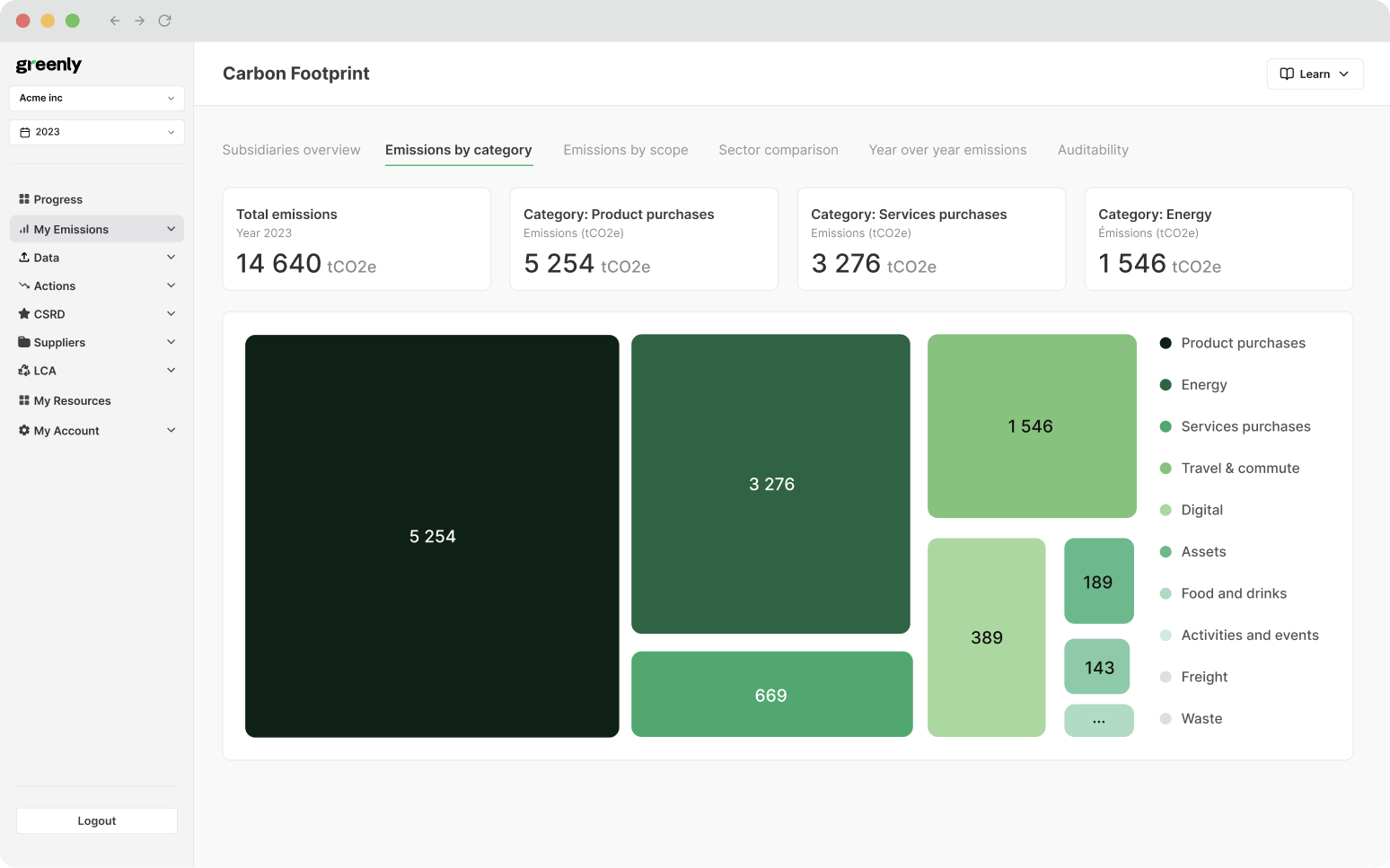
Greenly’s platform supports data collection across both direct and indirect emissions, helping you meet EU methodology requirements and avoid reporting gaps.
Streamline supplier data collection
Use tailored CBAM questionnaires, automated follow-ups, and supplier-specific dashboards to collect accurate emissions data – no spreadsheets required.
Track evolving supply chains
As new products or suppliers are added, Greenly automatically triggers new data requests, keeping your reporting up to date without extra admin.
Centralized supplier collaboration
Give your suppliers access to their own dedicated portal where they can upload data, access guidance, and contribute directly to your reports.
Improve accuracy, reduce risk
Built-in quality checks and real-time insights help you spot issues early, reduce reporting errors, and stay ahead of rising carbon allowance costs.
Automate quarterly reporting
Generate compliant XML reports in minutes, ready for direct upload to the EU portal. Our platform detects CBAM goods, flags missing data, and handles formatting automatically.
Whether you’re an EU declarant or an international supplier, Greenly’s all-in-one CBAM solution is designed to save time, lower costs, and help you reduce emissions while staying compliant.
In this article, we’ll explore five of the leading carbon management software platforms available today. Whether you're looking to measure your carbon footprint, create actionable decarbonisation plans, or meet regulatory requirements, these tools can help you build a more sustainable future.







 Sources